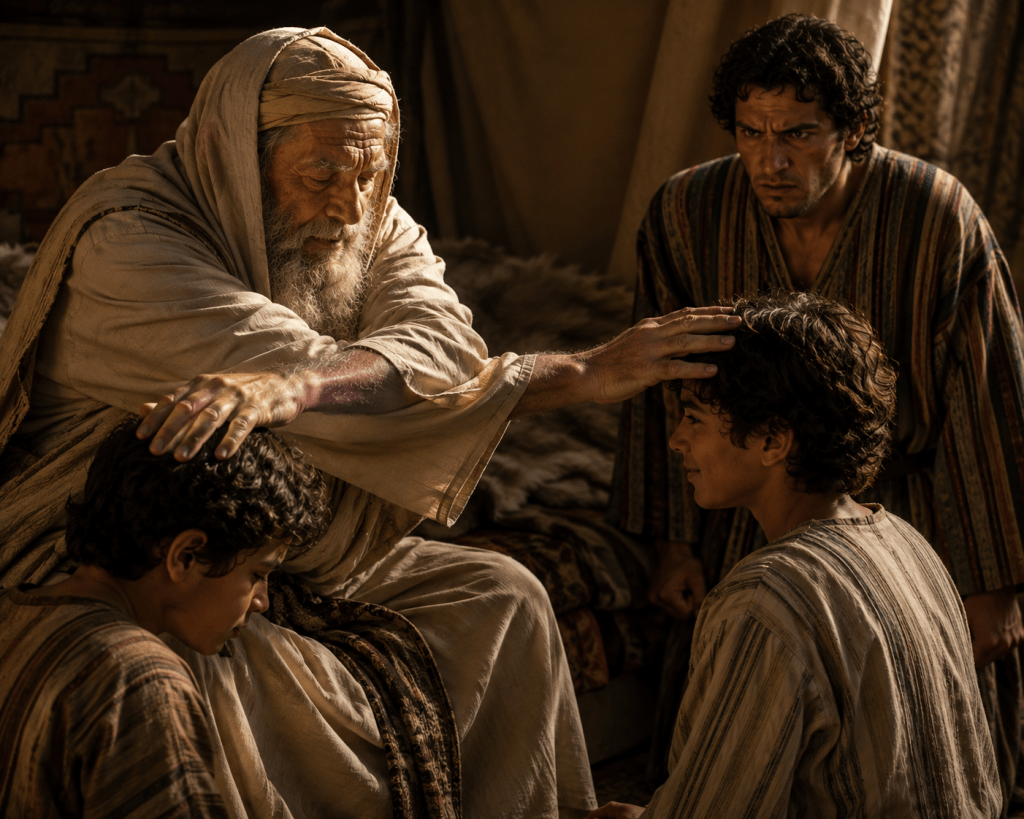
“The older shall serve the younger.” — Genesis 25:23
When I finished writing Part One, one thought refused to leave me. It’s easy to celebrate the people God chose. It’s much harder to imagine being the one He passed over.
We admire Abel’s faith, Joseph’s dreams, David’s anointing, and the prodigal son’s restoration because we know how their stories end. But what about the brother standing in the background?
What did Esau carry home after Jacob received the blessing? What did Manasseh feel as Jacob deliberately crossed his hands and placed his right hand upon Ephraim instead? How did Aaron process watching his younger brother become Israel’s leader? What was the older brother hearing as music and dancing filled the house for the son who had squandered everything?
Scripture doesn’t answer every one of those questions. Perhaps it doesn’t have to, because most of us already know what those moments feel like. We’ve watched someone else receive the promotion we prayed for. We’ve seen another person’s ministry flourish while ours remained unnoticed. We’ve celebrated a friend’s breakthrough while quietly wondering when God would remember us. We’ve smiled in public while grieving in private.
Being passed over hurts.
The Church is often quick to tell people, “Don’t compare yourself to others.” While that’s good advice, advice given before pain is acknowledged rarely heals anyone. Before we talk about theology, we need to admit something simple: rejection hurts. Being overlooked hurts. Watching someone else receive what you longed for hurts. God never asks us to pretend otherwise.
Why It Hurt So Much
Part of the reason these stories disturb us is because we often read them through modern eyes. Today, being the oldest child may come with a few extra responsibilities, but it rarely determines your future. In the ancient world, however, birth order shaped almost everything.
The firstborn son inherited a double portion of his father’s estate (Deuteronomy 21:17). He became the head of the family after his father’s death and carried the family’s name, authority, and legacy. This system, known as primogeniture, wasn’t merely a family tradition; it was the foundation of society. Your birth order determined your future before you had done anything to deserve it. If you were the firstborn, privilege came automatically. If you weren’t, you simply accepted your place.
Now imagine the shock every time God overturned that expectation. Isaac instead of Ishmael. Jacob instead of Esau. Ephraim instead of Manasseh. David instead of seven older brothers. It wasn’t simply that someone else received a blessing. It felt as though the entire order of life had been overturned.
To lose the blessing was not merely to lose an opportunity. It often felt like losing your identity. Suddenly Esau’s tears make more sense. Joseph’s brothers become more understandable. Even the elder brother in Jesus’ parable doesn’t seem so difficult to relate to. Their reactions were deeply human.
What God Never Condemned
As I reflected on these stories, I noticed something I had overlooked for years. God never condemned people simply because they were hurt.
He never rebuked Esau for weeping. He never mocked the elder brother’s confusion. He never ignored Cain’s disappointment. Instead, He met people in their pain.
Before Cain ever murdered Abel, God spoke to him:
“Why are you angry? Why has your face fallen?… Sin is crouching at your door; it desires to have you, but you must rule over it.” (Genesis 4:6–7)
Those words changed the way I read the story. God acknowledged Cain’s pain before confronting Cain’s sin. He saw the wound before He addressed the response.
That distinction matters.
Being disappointed isn’t sin. Feeling overlooked isn’t sin. Crying because your heart has been broken isn’t sin. The danger begins when hurt hardens into bitterness, disappointment becomes envy, rejection turns into resentment, and comparison convinces us that someone else’s blessing means there is less of God’s love left for us.
God wasn’t warning Cain about his emotions. He was warning him about where those emotions could lead if they were left unchecked.
God Wasn’t Creating Evil—He Was Revealing It
For years I assumed God’s choices created the conflict. Now I believe they simply revealed what was already there.
An X-ray doesn’t create a broken bone. It reveals the fracture. In much the same way, God’s unexpected choices revealed the condition of the human heart.
Abel’s acceptance didn’t create Cain’s jealousy; it exposed it. Joseph’s dreams didn’t create his brothers’ hatred; they revealed it. David’s anointing didn’t create Saul’s insecurity; it brought it into the open. The father’s celebration didn’t create the elder brother’s resentment; it simply uncovered what had been quietly growing inside him all along.
Perhaps that’s one reason God keeps overturning human expectations. Not to create rivalry, but to reveal what comparison has been hiding. His choices expose what comfort often conceals. And once something is exposed, it can finally be healed.
As I reflected on Cain’s story, I realized I wasn’t just studying him, I was seeing myself.
Not long ago, I poured my heart into a project I genuinely believed God had prepared me for. When the opportunity came, someone else was chosen instead. I smiled on the outside, said all the right spiritual things, and congratulated them. But when I was finally alone, I couldn’t ignore the ache. It hurt more than I wanted to admit.
In that quiet place, I sensed the Holy Spirit asking me the same question God once asked Cain: “Why are you angry? Why has your face fallen?”
It wasn’t a question asked to shame me. It was an invitation to be honest. Beneath my disappointment was something deeper than I had realized. My hurt was slowly becoming comparison, and comparison was beginning to question God’s goodness toward me.
That’s when this stopped being someone else’s story.
It became mine.
Grace Cannot Be Inherited
This is where the story becomes even more beautiful. God wasn’t rejecting firstborn sons. He was rejecting the belief that His blessings could be controlled by human systems.
The world says birth determines blessing. God says purpose does.
The world says privilege is inherited. God says grace is given.
The world says status comes first. God says, “I look at the heart.”
Every time God crossed His hands, chose the shepherd, or bypassed the obvious heir, He was declaring the same truth: My grace cannot be inherited like property.
It cannot be earned through status. It cannot be claimed because of birth order. It has always been, and always will be, a gift.
Sharon Paulina Boye
August 2, 2026


Leave a Reply