Welcome to Day 6.
After yesterday, this is where it leads.
Because once God heals what you’re holding… He starts asking what you’re willing to release.
If you’ve recognized that you are part of the remnant, then this is where it becomes real. Being the remnant is not just about identity. It is about consecration.
And consecration is not a popular message in this generation.
Consecration means being set apart, not just in what you say, but in how you live. It touches your lifestyle, your choices, your posture, your devotion. It means your life no longer belongs to you in the way it once did.
Romans 12:1 calls us to present our bodies as a living sacrifice. Not a temporary offering. Not a moment of emotion. A living sacrifice means daily surrender, ongoing yielding, a life laid down.
This is where many draw back.
Because everyone wants purpose, but not everyone wants the cost of purity. Everyone wants to be used by God, but not everyone wants to be refined by Him.
Let’s be honest.
You cannot carry God’s power and still hold onto everything He is asking you to release. You cannot live fully consecrated and still be half-committed. You cannot be the remnant and blend in with everything around you.
Joshua 3:5 says, “Consecrate yourselves, for tomorrow the Lord will do wonders among you.” Notice the order. Consecration comes before the move of God.
We keep asking for revival. We ask for God to move, for transformation in our generation. But revival does not begin in crowds. It begins in consecration.
It begins in the hidden yes.
It begins in turning away from what is common and choosing what is holy. It begins when you stop negotiating with the things God has already told you to release.
This is the reality of being the remnant in this day and time.
It means you may look different. Your decisions won’t always make sense to others. You will walk away from things people are still comfortable in.
Not because you think you are better, but because you have been called deeper.
2 Timothy 2:20–21 speaks about vessels of honor, set apart and useful for the Master. That means there are things that determine usefulness, not worth, but readiness.
God loves you fully, but He prepares you intentionally.
And preparation requires separation.
This is not about legalism. This is not about perfection. This is about love.
Because when you truly love God, obedience stops feeling like restriction and starts becoming response.
John 14:15 says, “If you love Me, keep My commandments.” Not out of fear, but out of relationship.
So what does consecration look like practically?
Consecration is not just a feeling. It shows up in real decisions.
If you are a vessel, then what you allow into your life matters.
2 Timothy 2:21 makes it clear that if a person cleanses themselves, they become a vessel for honor, set apart and useful. That means usefulness is connected to how you live.
So let’s make this real.
A consecrated person does not live casually with things that dull their sensitivity to God. This affects your habits, your environment, and your relationships.
You asked the question, is kissing a sin if you are not married?
Scripture may not list “kissing” directly, but consecration is not about finding the line. It is about guarding your heart and your purity.
1 Thessalonians 4:3–5 says this is the will of God, your sanctification, that you avoid sexual immorality and learn to control your body in holiness and honor.
So the real question is not “is this allowed?”
The real question is, “does this lead me toward purity, or toward compromise?”
For many, physical intimacy awakens desires meant for covenant. Once those desires are stirred, it becomes harder to remain disciplined.
So a consecrated person chooses wisdom over permission.
Not because they are restricted, but because they are guarding something sacred.
This applies beyond relationships.
A consecrated person does not entertain everything just because it is normal. They do not stay in environments that constantly pull them away from God. They do not ignore conviction when the Holy Spirit is clearly prompting them.
At the same time, consecration is not about becoming rigid or self-righteous.
A consecrated person loves deeply. They walk in humility. They extend grace to others. They understand they are still being refined.
This is not about perfection. It is about direction.
You are a vessel.
And vessels carry something.
So the question becomes, what are you carrying, and what are you making room for?
Because the remnant are not just people who believe. They are people who are available.
And availability requires space.
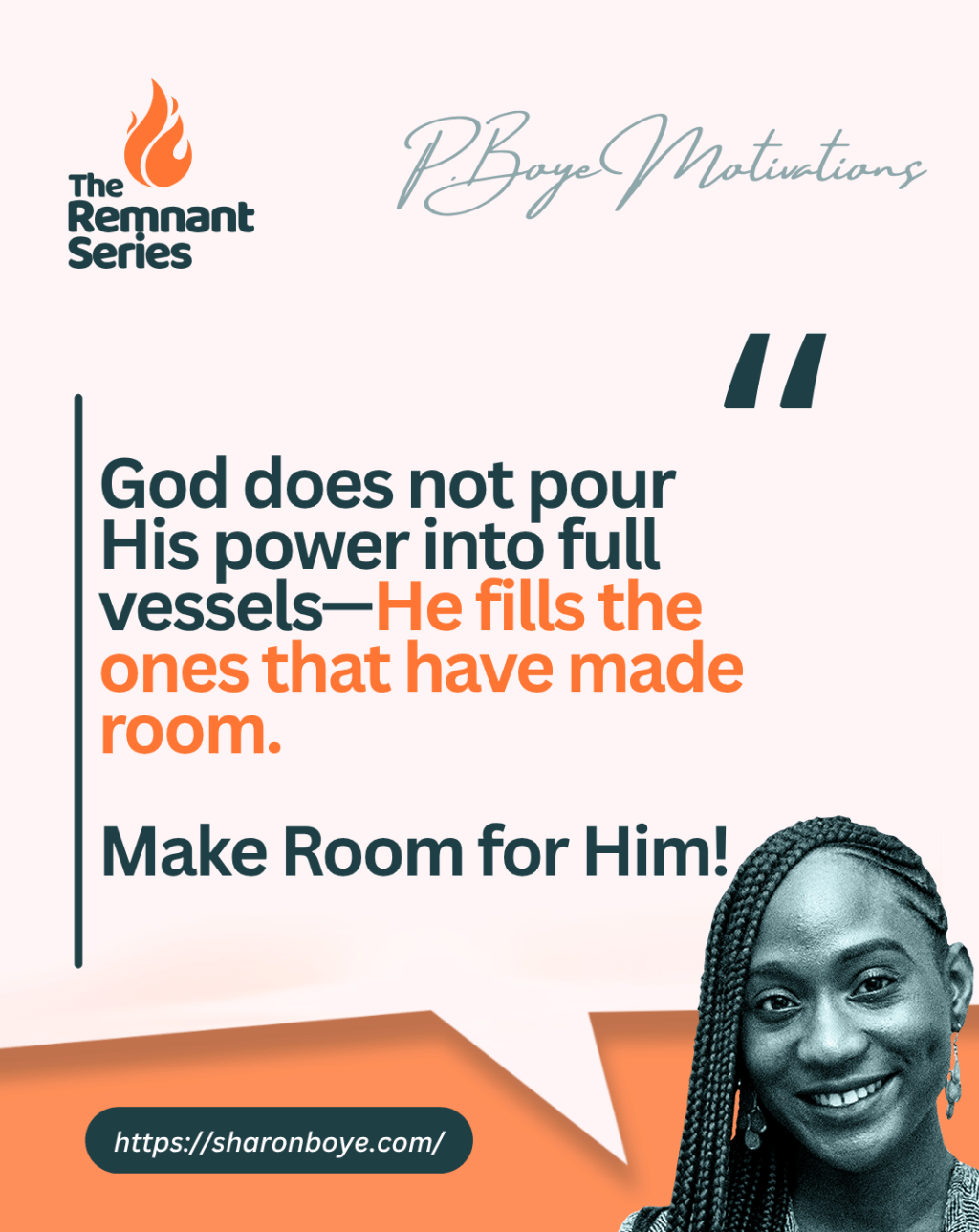
God will not pour into a life that is already full of everything else.
So consecration is making room.
Making room in your thoughts. Making room in your habits. Making room in your relationships.
Not out of fear, but out of love.
Because when you understand who you belong to, you start living like it.
So if we are serious about seeing God move in our generation, it starts here.
Not with noise. Not with performance. But with surrender.
Let this be the moment you stop playing small.
Let this be the moment you stop delaying obedience.
Let this be the moment you fully say yes.
Because the remnant that God is raising in this hour will not be casual, compromised, or comfortable.
They will be consecrated.
And that is where the fire falls. 🔥
Sharon Paulina Boye
April 25, 2026


Leave a Reply