Dear Reader,
You Might Be the Difficult Person: What Happens When You’re the One Stirring the Pot?
Let me paint a picture for you: You’re in the middle of an argument, whether it’s with your sibling, partner, or a friend, and you’re thinking, “This person just doesn’t get it! Why are they so difficult?” You’re frustrated, and you can’t help but feel like you’re the one being pushed to your limit. But hold on—what if you’re the one causing all the drama?
I know, I know, it’s a tough pill to swallow, but hear me out. Sometimes, the person making everything tense, uncomfortable, or difficult is not the one you’re blaming—it’s actually you.
I’m sure you’ve been there—at the family gathering where everything is peaceful until someone says something, and before you know it, you’re raising your voice, throwing your hands up, and wondering why everyone’s looking at you like you’ve set off a bomb. Or maybe you’re the one who shuts down the moment things don’t go your way, refusing to even listen.
But here’s the thing: In many situations, we don’t realize that we are the ones causing the storm. And before we start pointing fingers, it’s time to turn the mirror on ourselves. Are we making things harder than they need to be? Could we be the difficult person without even knowing it?
- Self-Awareness: Recognizing You’re the Storm
Have you ever had one of those days where you’re already upset before you even leave the house? Maybe you woke up on the wrong side of the bed, or your boss gave you a difficult task, or you just didn’t sleep well. And then, all it takes is one little thing—maybe a comment from your cousin or a small misunderstanding with your friend—and suddenly, you explode.
In that moment, you might think everyone else is at fault. “Why did she have to say that?” or “Why does he always do this to me?” But, if we’re being honest, sometimes it’s us—our mood, our frustrations, and the baggage we carry—that turn a small issue into a big problem.
It’s common in African families, especially, to react quickly, to defend ourselves, and to not let anything slide. “Who does she think she is? I won’t let her talk to me like that!” But, self-awareness is the first step in realizing that we might be the ones creating unnecessary tension.
Take a moment to think about it—when was the last time you snapped at someone over something small? Was it really about what they said, or was it about the frustrations you were carrying from earlier? Recognizing your role in a conflict is the first step towards handling it better next time.
- Reacting or Responding? The Choice Is Yours
We’ve all been there, right? Someone says something that rubs us the wrong way, and before we even have a chance to think, our emotions take over. “Did you just say what I think you said?” “Who do you think you’re talking to?” In that split second, you’re ready to fight back. This is what we call reacting—jumping straight into a situation without thinking about how it will affect others.
You see, in our African cultures, we’re often taught to stand our ground, to not let anyone walk over us. That’s good in some situations, but it can also make us react harshly, without considering the consequences. You might raise your voice at a friend, a colleague, or even a relative, and the argument spirals out of control. Suddenly, you’re the difficult one, and no one’s really listening to you anymore.
But what if, instead of reacting, you responded? Let’s say you’re at a family gathering, and someone says something that bothers you. Instead of snapping, take a deep breath, and pause for a second. Respond calmly: “I see where you’re coming from, but I don’t agree with that.” This approach shows maturity and respect, and you’ll likely find that the conversation becomes more productive rather than escalating into a full-blown fight.
Reacting out of anger might feel good in the moment, but it often leaves you with regret and broken relationships. Responding, on the other hand, allows for understanding and keeps the peace.
- Are You Really Listening, Or Just Waiting to Talk?
One thing we all know is that the African way of talking is… lively. We interrupt each other, we raise our voices, and we argue with passion—whether it’s about politics, football, or who should do the dishes. But, sometimes, that passion turns into conflict, especially when we don’t listen.
Have you ever been in a conversation where someone is trying to speak, but you’re just waiting for them to finish so you can make your point? “Wait, wait, wait—let me tell you something!” Sound familiar?
This happens all the time, especially when we feel like we’re not being heard. But when you interrupt or don’t give someone a chance to finish, it can make them feel invalidated. They might start to get defensive, which can turn a peaceful conversation into a battle.
Next time you’re in a conversation, try this: instead of interrupting, really listen. Let the other person speak and give them space to explain themselves. When it’s your turn, you’ll find that the conversation is more respectful, and you’re less likely to be the one causing the tension. Listening is one of the best gifts we can give someone—and it also helps us avoid being the difficult one.
- Apologizing: The Simple Power of Saying “I’m Sorry”
As an African, admitting that we were wrong can be tough. We were raised with pride, and it’s often hard to humble ourselves and admit when we’ve made a mistake. But if we’re being honest, we’ve all been there: snapping at someone, shutting them down, or saying something we didn’t mean in the heat of the moment.
Here’s the truth, though—owning up to our behavior and saying “I’m sorry” can go a long way. It doesn’t make you weak or small; it makes you human. When you apologize, you’re taking responsibility for your actions, and that is powerful.
For example, after an argument with your partner, you realize you were too harsh, and it wasn’t their fault. You can either let the pride take over and let the tension linger, or you can apologize: “I’m sorry for raising my voice earlier. I was frustrated, but that’s no excuse.” When you apologize, it opens the door for healing and shows that you care about the relationship.

As we like to say in many African cultures, “An apology is the oil that keeps relationships running smoothly.” It might feel difficult at first, but it’s an important step in creating peace.
- Attitude Is Everything: Choose to Bring Positivity
We’ve all met those people who just seem to carry negativity everywhere they go. They complain about everything, from the food to the weather to the traffic. Over time, that negativity can drain the energy out of the room, and guess what? They become the difficult person.
But here’s the good news: you have the power to choose your attitude. If you wake up feeling grumpy or frustrated, it can affect your entire day. But if you choose to see the good, even in tough situations, you’ll bring a different energy to the people around you. A positive attitude is infectious—it lifts others up and makes you more approachable.
Instead of complaining about your long commute, why not use that time to listen to a motivational podcast or reflect on what you’re grateful for? Instead of criticizing someone’s efforts, try offering constructive feedback with kindness. Your attitude, as they say, determines your altitude.
- Growth: It’s a Journey, Not a Destination
The road to being a better version of yourself is not easy. You won’t get it right all the time, and that’s okay. We’re all a work in progress. The key is to recognize when we’ve made a mistake, take responsibility, and commit to improving.
It’s easy to focus on the flaws of others, but self-reflection is where the real change happens. We may not always be able to control how others behave, but we can control how we respond—and that’s where growth starts.
Remember: “A journey of a thousand miles begins with one step.” We don’t need to be perfect. We just need to keep moving forward.
Conclusion: Turning the Mirror on Yourself
At the end of the day, none of us are immune to being the difficult person from time to time. But the power is in our hands to change, to improve, and to foster peace in our relationships.
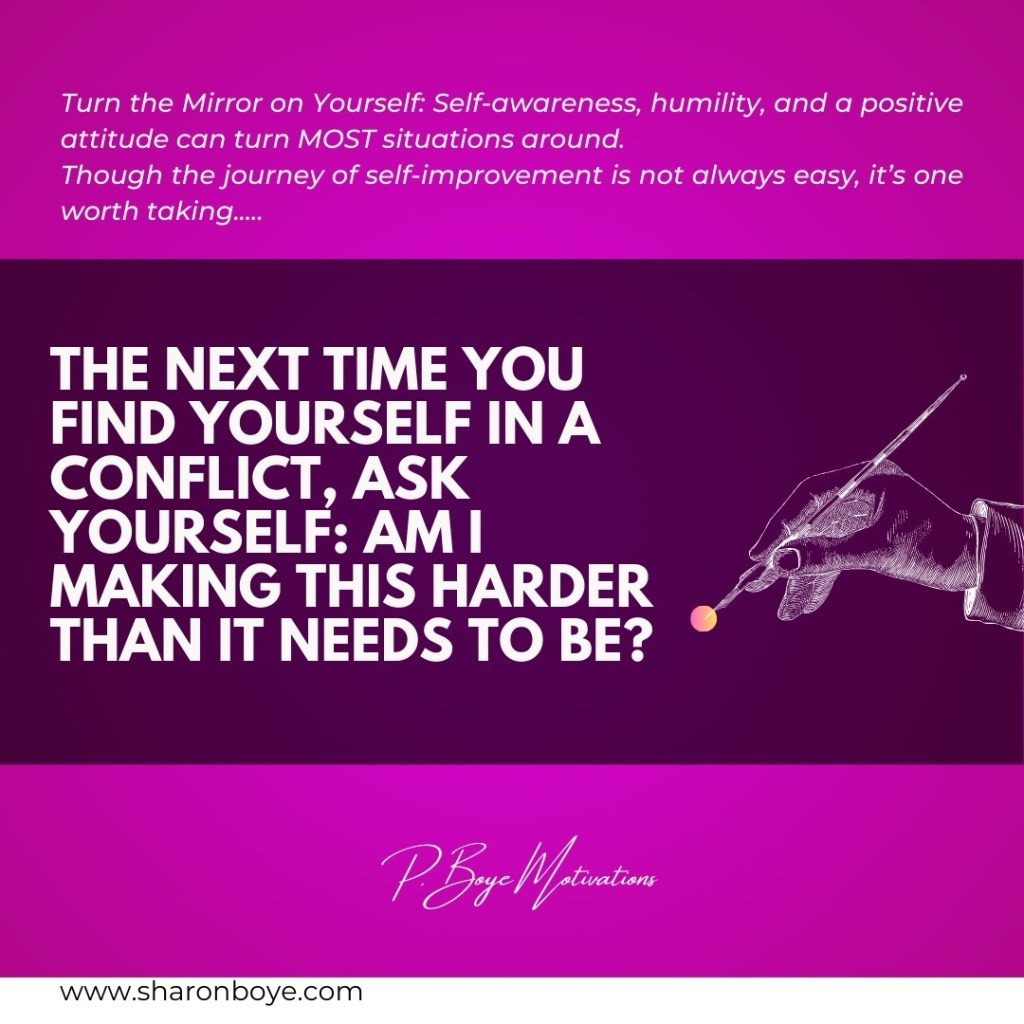
So the next time you find yourself in a conflict, ask yourself: Am I making this harder than it needs to be? Self-awareness, humility, and a positive attitude can turn MOST situations around.
Although the journey of self-improvement is not always easy, it’s one worth taking.
Sharon Paulina Boye
March 31,2025




Leave a Reply