
The scene opens with two siblings, SARAH (20) and JAMES (16), sitting on opposite ends of the couch. The tension in the room is palpable. A small disagreement has escalated into something much more serious
Sarah: You never think about anyone but yourself, James! You’re so selfish!
James: Oh, like you’re any better? Always acting like you’re Mum and Dad’s favourite, like you’re so perfect!
Sarah: Maybe if you weren’t so lazy and irresponsible, they wouldn’t be so hard on you!
James: At least I’m not a bossy control freak! You think you’re better than everyone, but you’re not! You’re just as messed up as the rest of us!
Sarah: You don’t get it, do you? I’m trying to hold this family together, but all you do is tear it apart with your stupid choices!
James: Right, because you’re the hero in this story, aren’t you? Always playing the martyr while you look down on the rest of us.
Sarah: You never listen! I’m trying to help you, but you just push everyone away! One day you’ll regret it, James. You’ll be alone, and it’ll be your own fault!
James: Don’t worry, Sarah. I won’t need anyone’s help, least of all yours. You think you’re better off without me? Fine. Consider me gone.
[James storms out, slamming the door behind him. Sarah stands there, breathing heavily, as the weight of their words sinks in. The room is now silent, but the damage is done.]
Dear Royalty,
Yesterday , we began our discussion on overcoming sibling rivalry through the fruits of the Spirit found in Galatians 5:22-23, exploring the impact of love, joy, and peace. Today, we’ll continue by looking at the remaining fruits: Patience, kindness, goodness, faithfulness, gentleness, and self-control.
Each of these virtues can play a crucial role in healing and strengthening sibling relationships, especially in situations of conflict and misunderstanding.
Your parents may not be able to assist build your relationship amongst your siblings and yourself as they should, but YOU are! You are responsible for how your life’s events play out even amongst yourselves as siblings!
4. Patience / Long Suffering / Forbearance
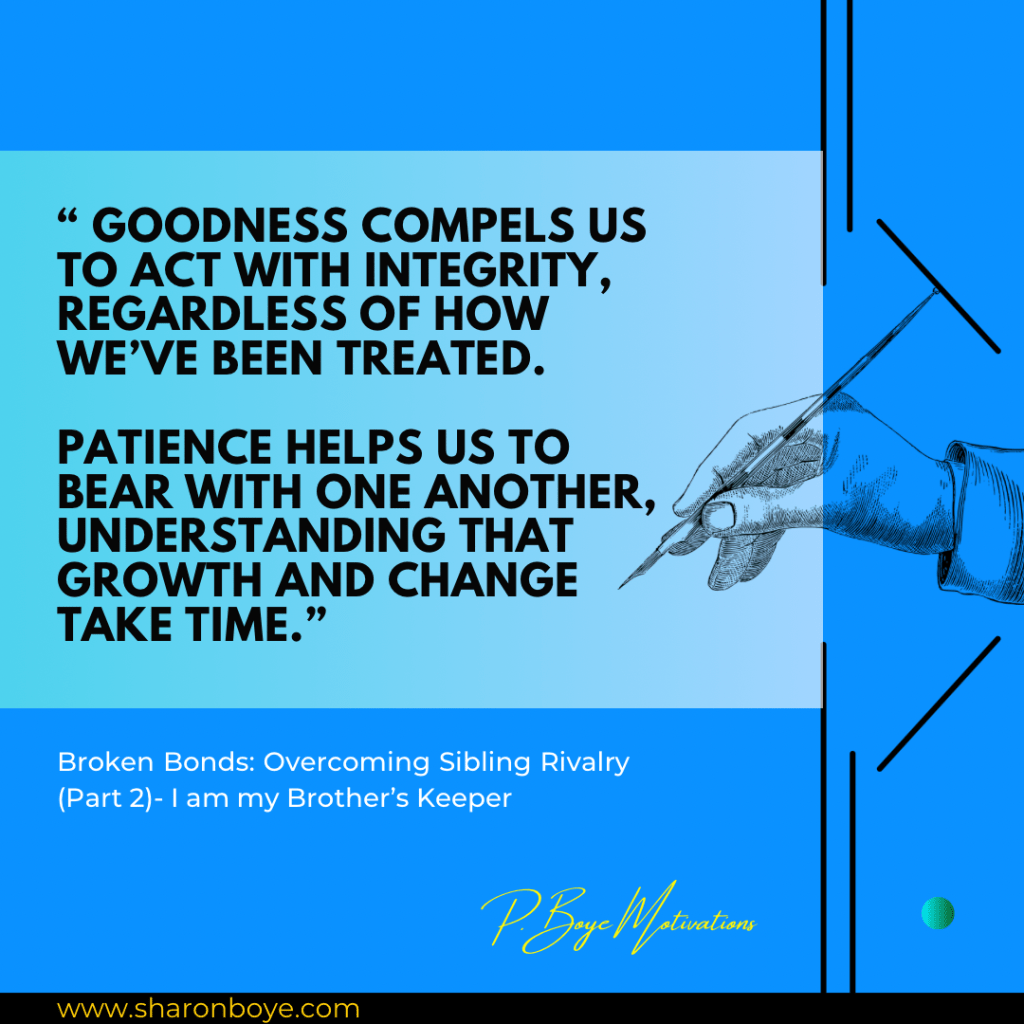
Patience is crucial in handling conflicts and misunderstandings. Imagine Sarah and James during their heated argument. If Sarah had chosen to exercise patience, she might have paused before responding to James’ hurtful words, recognising that his anger stemmed from deeper issues. Instead of reacting immediately, she could have given herself time to cool down, which might have prevented the escalation of the argument. Patience helps us to bear with one another, understanding that growth and change take time.
The concept of makrothumia which is the Greek word for longsuffering can be seen as having the patience of a candle with an endless wick, designed to keep burning for as long as it takes. It represents a deep capacity to bear with others, giving them the time and space to learn, change, or finally grasp the truth you’re trying to communicate.
5. Kindness
Kindness softens hearts and opens doors for reconciliation. During their exchange, James could have chosen to respond to Sarah’s criticism with kindness, perhaps acknowledging her concerns instead of lashing out. Even after the argument, an act of kindness, like offering an olive branch or an apology, could have broken the cycle of hostility between them. Kindness in the face of conflict can disarm anger and pave the way for healing.
6. Goodness
Goodness is about reflecting God’s character in our actions, especially when it’s challenging. If Sarah had chosen to embody goodness, she might have supported James despite her frustration, perhaps offering to help him with whatever was causing him stress. Even after their harsh words, goodness could have led either sibling to check in on the other, showing concern rather than holding onto resentment. Goodness compels us to act with integrity, regardless of how we’ve been treated.
7. Faithfulness
Faithfulness means being loyal and reliable, even in difficult times. In the context of Sarah and James, faithfulness might have meant standing by each other, even after harsh words were exchanged. For instance, Sarah could have continued to pray for James or supported him in other areas of his life, demonstrating that her care for him didn’t waver despite their argument. Faithfulness strengthens sibling bonds by showing that our commitment to each other isn’t conditional on perfect harmony.
8. Gentleness
Gentleness in speech and action can prevent many conflicts. During their argument, if James had responded to Sarah’s frustration with gentleness, perhaps by calmly explaining how her words hurt him, the situation might have de-escalated. Even in the aftermath, gentle communication—like expressing feelings without accusation—could have helped them both to understand each other’s perspectives and move towards reconciliation. Gentleness turns potential fights into opportunities for deeper connection.
9. Self-Control
Self-control is vital in managing emotions and reactions. In the heat of the moment, both Sarah and James could have benefited from self-control, choosing to pause before letting their emotions dictate their words. By exercising self-control, they might have avoided saying things they would later regret. This virtue is crucial in moments of provocation, helping us to choose responses that reflect Christ’s love, even when our feelings are intense.
Application
These fruits of the Spirit are not just ideals; they are practical tools we can use to navigate the complexities of sibling relationships. The argument between Sarah and James, though common, illustrates how easily a minor disagreement can escalate into something far more damaging. However, by applying the fruits of the Spirit, their story could have had a different ending. Can you change the dynamics of your relationship with your siblings ?
For instance, if Sarah had approached the situation with patience, she might have waited until she was calm to discuss her concerns. If James had responded with kindness, the tension could have eased. Self-control could have helped both of them to speak and act with love, even in the midst of their frustration.
Prevention indeed is better than cure . It’s even more expensive to cure than to prevent the mishap from occurring , I would say.
Conclusion: I Am My Brother’s Keeper
In conclusion, let us commit to being our brothers’ and sisters’ keepers, not just in words, but in our actions and attitudes. The fruits of the Spirit provide us with a blueprint for nurturing healthy, loving, and supportive relationships with our siblings. When we embody these virtues, we not only prevent conflicts but also build bridges of understanding and love. Indeed, rather than saying, “Am I my brother’s keeper?” like Abel asked, let us boldly declare, “I am my brother’s keeper.” Let’s embrace this responsibility of ensuring God rules in our family affairs with love, joy, peace, patience, kindness, goodness, faithfulness, gentleness, and self-control, so that we can overcome rivalry and build stronger, more loving families.
Remember 1 Corinthians 13
4 Love is patient, love is kind. It does not envy, it does not boast, it is not proud. 5 It does not dishonor others, it is not self-seeking, it is not easily angered, it keeps no record of wrongs.6 Love does not delight in evil but rejoices with the truth. 7 It always protects, always trusts, always hopes, always perseveres.8 Love never fails…
With hope and Love ,
Sharon Paulina Boye
August 10, 2024




Leave a Reply