Dear Royalty,
Today, I want to address a family issue that has existed for as long as families themselves: sibling rivalry. It’s a challenge many households face, but there’s hope for resolution through understanding and love.
Before diving deeper, I want to offer a prayer for you, dear reader. I decree peace in your home, love and unity in your family. May every source of disagreement, misunderstanding, and discord be silenced in the powerful name of Jesus. Amen.
Sibling rivalry is a significant concern, one that weighs heavily on the heart of God for our generation. We often hear stories of conflicts between step-siblings or the tension between a firstborn and younger siblings. The enemy seeks to disrupt the family unit, but as Christian soldiers, we must stand vigilant. It is essential to treat each other with love and understanding, though it may not always be easy.
Consider the stories of Cain and Abel, Esau and Jacob. Why did Cain kill Abel? Why did Esau despise Jacob? These biblical figures are often viewed as villains, but let’s not forget they were human, just like us. The same emotions and temptations they faced can affect us today.
You may argue that you’re not Cain, nor Esau, but what makes you certain you’d act differently if placed in their shoes? Some say Esau was foolish to give away his birthright, but imagine how you’d feel if your own mother conspired to take away your blessings because of a careless word you uttered. After all, Esau did not particularly know that a prophecy had gone ahead of him and his brother.
I don’t wish to sugarcoat the reality—Cain’s experience was painful. His sacrifice was rejected while Abel’s was accepted, which must have hurt deeply. Yes, Cain failed to offer his best, but wouldn’t you feel disappointed if your efforts were repeatedly dismissed?
The key message here is that we must address bitterness before it consumes us and leads to irreversible damage. Once you sense bitterness or anger lurking, deal with it immediately. It’s easy to preach forgiveness after the harm is done, but the process of healing from such pain and trauma can take a lifetime.
So, how do we prevent sibling hurt and rivalry in the first place? I believe one of the main concerns of many people is the idea of , ‘ coming from the same family or having similar life experiences; therefore, why should my siblings life suddenly be ‘better’ than mine?’

Let’s approach this from the perspective of the fruits of the Spirit. The Bible teaches us about love, joy, peace, patience, kindness, goodness, faithfulness, gentleness, and self-control in Galatians 5:22-23. By embodying these virtues, we can significantly reduce the occurrence of sibling rivalry.
1. Love
Love is the foundation of all relationships. Imagine a situation where one sibling feels overshadowed by another’s achievements. Rather than harbouring resentment, love compels us to celebrate our siblings’ successes as if they were our own. In a real-life scenario, a sister might feel envious of her brother’s academic accolades. However, by choosing love, she actively supports him, attending his events and praising his hard work, thereby strengthening their bond.
2. Joy
Joy is finding contentment in all circumstances. Let’s say your younger sister lands a job before you, even though you’re older. Instead of feeling bitter, joy allows you to celebrate her achievement genuinely. This joyful attitude creates a positive atmosphere in the home, where everyone’s victories are shared and appreciated, fostering unity rather than division.
3. Peace
Peace involves striving for harmony in relationships. If an argument arises between siblings, the fruit of peace urges us to be peacemakers. For instance, if two brothers are constantly at odds, peace would prompt them to seek reconciliation through honest communication and mutual respect, rather than allowing the conflict to fester.
Secondly, Do Not Confuse Peace with Silent Treatment or Keeping Malice
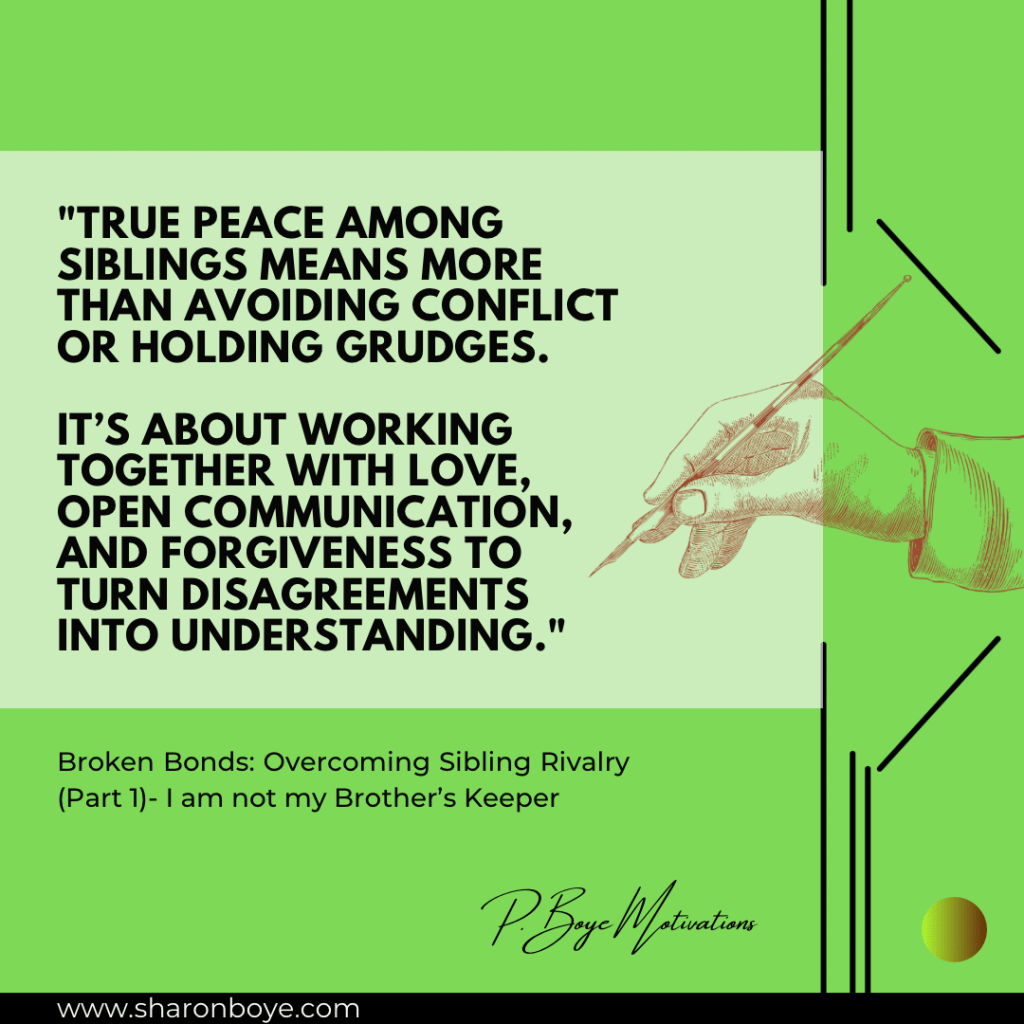
It’s important to understand that true peace in relationships is not the same as giving someone the silent treatment or keeping malice. Peace is about actively seeking harmony and resolution in our relationships. It involves open communication, understanding, and the willingness to forgive and reconcile.
On the other hand, silent treatment and keeping malice are forms of passive aggression. When you give someone the silent treatment, you are deliberately withholding communication, often as a way to punish the other person or avoid dealing with the conflict. This behaviour can create an illusion of peace because there’s no visible argument, but underneath, the tension and resentment continue to grow.
Similarly, keeping malice means holding onto bitterness and resentment without addressing the underlying issue. While it may appear that you’re maintaining peace by avoiding confrontation, in reality, you’re allowing negative emotions to fester, which can lead to deeper divisions and more significant conflicts in the future.
True peace requires that we confront issues with love, address misunderstandings, and work towards genuine reconciliation. It’s not about avoiding problems or pretending they don’t exist, but rather about resolving them in a way that fosters mutual respect and understanding.
Action Point: Take time today to reflect on how you can actively incorporate love, joy, and peace, into your relationships with your siblings. Whether it’s celebrating their achievements, choosing peace over conflict, or practising love in challenging moments, make a conscious effort to apply these fruits of the Spirit in your daily interactions.
These are just the first steps in applying the fruits of the Spirit to overcome sibling rivalry. Tomorrow, we’ll continue this discussion by exploring how the remaining fruits— Patience, kindness, goodness, faithfulness, gentleness, and self-control—can further transform our relationships with our siblings.
With Love ,
Sharon Paulina Boye
August 9, 2024




Leave a Reply